G. Steve Journal

Reflections on photography, art, beauty and the natural landscape.

Category: New Paltz, NY

  • Exception to the Standard

    Just wanted to share a spot-on excerpt from todays blog post by marketing guru Seth Godin.  As usual, he's made the distinction between what we may tell ourselves (as artists or otherwise) and what it is we really need to keep in mind:

    The other day, after a talk to some graduate students at the Julliard School, one asked, "In The Dip, you talk about the advantage of mastery vs. being a mediocre jack of all trades. So does it make sense for me to continue focusing on mastering the violin?"

    Without fear of error, I think it's easy to say that this woman will never become the best violinist in the world. That's because it's essentially impossible to be the one and only best violinist in the world. There might be 5,000 or 10,000 people who are so technically good at it as to be indistinguishable to all but a handful of orchestra listeners. This is true for many competitive fields–we might want to fool ourselves into thinking that we have become the one and only best at a technical skill, but it's extremely unlikely.

    The quest for technical best is a form of hiding. You can hide from the marketplace because you're still practicing your technique. And you can hide from the hard work of real art and real connection because you decide that success lies in being the best technically, at getting a 99 instead of a 98 on an exam.

    What we can become the best at is being an idiosyncratic exception to the standard. Joshua Bell is often mentioned (when violinists are mentioned at all) not because he is technically better than every other violinst, but because of his charisma and willingness to cross categories. He's the best in the world at being Josh Bell, not the best in the world at playing the violin.
  • Kim Jong Phil!

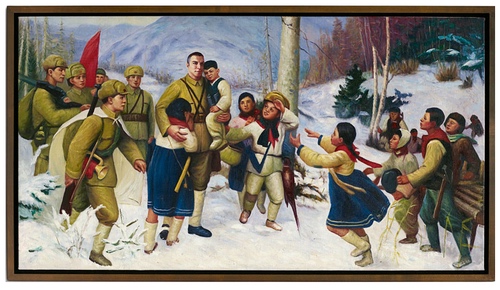
    Just came across this whimsical but spot-on musings of artist Phil Toledano:

    For years now, I’ve been thinking (on a Woody Allen level of obsession) what it means to be an artist.

    I reflect on the elaborate psychological mechanisms required to pursue something so elusive, so ambiguous. I alternate between wild confidence, sure and definite in my belief that i’m onto something, and wild despair. My ideas are shit. They’re relevant to no-one but myself. I often wonder: ‘Am I talking to myself?’

    I’ve never made work for other people. But as an artist, I need to be in dialogue with the world that exists beyond my overpopulated cranium.

    I’ve concluded that to be effective-to be functional-I must guzzle an eye-popping cocktail of delusion and narcissism.

    It occurred to me that being an artist is a great deal like being a dictator.

    Just like a dictator, I must live in a closed loop of self-delusion. A place where my words and ideas always ring true. A gilded daydream of grandiosity. There can be no room for doubt. I must be convinced that I have something vital to say. I must believe that the world is waiting in keen anticipation to hear my message.

    For my palette, I’ve copied pre-existing dictatorial art. Paintings from North Korea, statues of assorted dictators (Kim Il Sung, Laurent Kabilla, and Saddam Hussein). I had these works re-created in China, and each instance, I’ve replaced the great leaders with myself.

    Picture 3
  • Magical Thing

    I can't say I'm a big Tom Waits fan – it seems to me to be an acquired taste – but it's hard not to respect him and the path he's on.  Like that line from The Band song "Cripple Creek:" "I can't stand the way he sings, but I love to hear him talk."

    Well, Waits did talk at length with Terry Gross on an episode of Fresh Air and I thought his musings on songwriting could be applied to any creative endeavor — just insert the name of the medium, say photography instead of songwriting — and change a few details and, voila, same deal:

    "For a songwriter, you don't really go to songwriting school; you learn by listening to tunes. And you try to understand them and take them apart and see what they're made of, and wonder if you can make one, too," he says. "And you just do it by picking up the needle and putting it back down and figuring it how these people did this magical thing. It's rather mystifying when you think about songs — where they come from and how they're born. Many times, it's very humble and very mundane, the origin of these songs."

  • Perfection

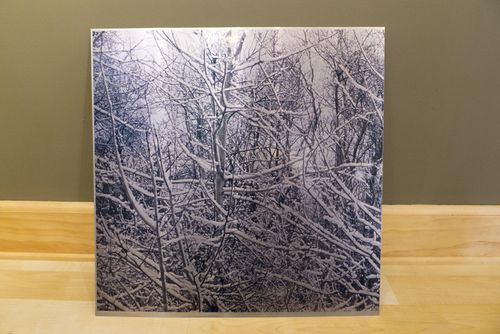
    The 10-panel aluminum polyptych now on display in the gallery shows some artifacts of it's creation: scratches, smudges..etc. and I find that it's this very quality that let's the viewer know it's not mass-produced.

    Reflecting on this I realized that the same quirkiness that may be sought after in a work of art — evidence of it's uniqueness — may be attractive in our friends and acquaintances as well, as expressed by this quote I stumbled upon:

    “The errors of a man are what make him really lovable.”

                                                                     — Goethe


  • Art + Science = Beauty

    I came across this thoughtful and provocative video narrated by the late physicist Richard Feynman, about how science informs his perception of natural beauty, as well as his worldview.  Even if one disagrees with his personal conclusions, his insights and willingness to ask important questions is refreshing.

    044
  • Visceral

    Just read about an exhibit of the W.M Hunt photography collection at the George Eastman House in Rochester, NY that included this advice Hunt gives new collectors:

    Open yourself up to the visceral experience of looking at photographs and pay attention to what makes your heart beat faster—not what makes your head pound.

    What a refreshing sentiment and one that should be considered when experiencing any creative expression — from music to poetry to visual art.

  • The Creative Process

    I never tire of learning how the creative process is manifested for others and came across an article in the most recent CHRONOGRAM about author Esmerelda Santiago where she talks about her own experience, which is remarkably similar to so many others:

    I really don't believe I'm creating anything.  What I'm doing is setting down something that's coming to me from some mystical source that I don't understand, but don't want to get mad at me. [laughs] I really believe these muses as an artist are these forces that are there to help you and nurture you, but you have to help them, too.

  • Going Deeper

    That's the title of the show we're working on here at the gallery, and refers to our ever-evolving effort to explore what lies beneath the surface of an image.  It was the advent of the large-format nature photography book in the 1970's, most notably the Sierra Club book that paired Eliot Porter images with selections from Thoreau's journals, that provided us the first clue there may be more to a photo than meets the eye.

    Since then, and following in the manner of Porter, we've tried to do more than simply document the landscape photographically. This latest effort, printing images on a variety of alternative media, is simply one more layer removed from the representative landscape and towards the expressionistic.

    For the show we've tried to choose media that complement each of four different images: fabric for a spring panoramic, canvas panels for summer, wood for autumn and aluminum panels for an icy winter scene. 

    Here is a photo of one of the ten 2'x2' panels that will make up the final 4' x 10' winter scene.

    AlumPanel


  • Your “Gloria”

    I never seem to tire of examining what it is that contributes to creative endeavors and I came across this passage in the novel "Cutting For Stone" by Abraham Verghese in which the adult Matron is chastising the child Marion for being lazy:

    How easily Matron probed the gap between ambition and expediency.  "Why must I do what is hardest?"

    "Because, Marion, you are an instrument of God.  Don't leave the instrument sitting in it's case, my son. Play! Leave no part of your instrument unexplored.  Why settle for 'Three Blind Mice' when you can play the 'Gloria'?"

    …"But, Matron, I can't dream of playing Bach, the 'Gloria'…,"

    "No, Marion," she said…. " No, not Bach's 'Gloria.'  Yours!  Your 'Gloria' lives within you.  The greatest sin is not finding it, ignoring what God made possible in you."

  • Artist’s Wish

    It's always entertaining to search for and discover quotations I can pair with the images on the calendar I publish every year  – here's one of my favorites from the upcoming 2012 calendar:

    I would like to paint the way a bird sings

                                               – Claude Monet