G. Steve Journal

Reflections on photography, art, beauty and the natural landscape.

Category: New Paltz, NY

  • “The War of…

    Art" and "Anything You Want" are two very brief but very powerful books on the creative process, though they take very divergent paths.

    Steven Pressfield's "The War of Art" is a manifesto urging the reader to conquer resistance  — the resistance that prevents us from doing what it is we need to do. At times admonishing and at times metaphysical, this is the kind of book one wants to keep close at hand as a reminder when straying from the task at hand. As an Esquire review put it, Pressfield's book is: "…a kick in the ass."

    Conversely, Siver's "Anything You Want" is an abbreviated inside look at Derek Sivers' ten-year adventure as the founder of CD Baby, an early online music business.  Sivers, a musician, makes it clear he has the discipline to do what it is he sets out to do and it's a fascinating read.  The upshot: be sure that whatever it is you are doing serves the ultimate goal of being happy.  He concludes that money and possessions are not as important to him as the freedom to live a more nomadic life — a very unusual but refreshing conclusion from a "successful" business-owner who made millions from his brainchild.

    Both worth a look…
  • What We Know

    A friend sent me this link about how what we know — or don't know — clearly affects our perceptions…

  • Perfect Day For…

    Yesterday was a perfect summer day, and a friend and I set out early to enjoy the morning and see if we could capture some images. 

    The sky was a cloudless blue – it was the kind of day that visitors to the gallery often remark is, "the perfect day to take pictures."  I don't usually bother to correct them:  those are the nicest days to be out with a camera, but they are the most difficult for a landscape photographer, since a sky without clouds tends to also lack personality.

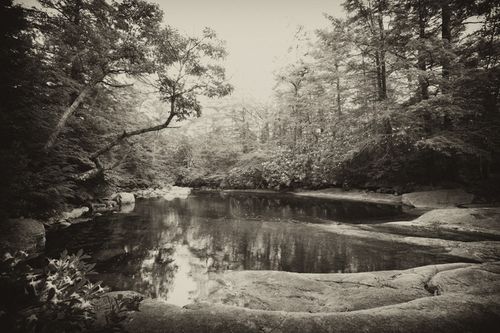
    We hiked along one of the many streams in the area and, as I wrote about in an earlier post, I liked the composition of many of the images but not the color — a homogenous summer green.

    I converted to B&W, as I did the earlier image, and the end result expresses, for me, the timeless feeling of this setting.

    5050
  • Soulful

    I read a wonderful interview with the actor Wendell Pierce, who plays the laconic Antoine Batiste in the HBO series Treme, about New Orleans after Hurricane Katrina.  If you haven't seen this series yet, consider putting it on your Netflix queue, if only for the musicians featured, like Dr. John and Kermit Ruffins.

    Pierce, a New Orleans native, talks about the vital music scene there and observes that how music is played — from the heart — "soulful" — is just as important, if not more so, than hitting all the notes.

    On reflection, that's probably true for most creative endeavors, including photography.  If a work of art — poem, painting, photo – doesn't speak from that soulful place, then ultimately it doesn't really connect with the audience on the level that art should.

    CroceB&W
  • Art

    A friend recomended a Jaques Barzun essay collection and, being unfamiliar with this author, I did some searching online and came upon a selection of quotations attributed to him, one of which I found especially trenchant:

    Art distills sensation and embodies it with enhanced meaning in a memorable form – or else it is not art.

                                                                                                                         –– Jacques Barzun


    2133

  • De-bullshytte-ify!

    From boingboing.net:

    Charlotte Young has produced an "artist's statement" video with handy subtitles intended to de-bullshytte-ify this often obscure literary form.

    Artist's Statement

  • Flow

    I was chatting with Terry Laughlin, founder and Head Coach of Total Immersion, which provides coaching to swimmers who are looking to improve.  Terry has always been very passionate about what he does – always looking to improve and constantly tweaking the techniques he teaches.

    As we compared notes about our respective paths, I realized that although most people would consider swimming and photography to have little in common, the approach we bring to our endeavors couldn't be more similar — an inquisitive outlook, an eagerness to explore new ways of experiencing how it's done and then how it can be done better.

    At the end of the day, this outlook may be found in most successful practitioners of any enterprise.  One realizes that the activity itself becomes secondary to it's practice — the practice transcends the literal and becomes an exercise in achieving a higher plane, regardless of the activity. Terry called it simply: "Flow."

  • Implicit, Not Explainable

    There's a study making the news of late (NYT June 14, 2011) about how we bring others around to our way of thinking and it's getting some coverage due to the assertion that we, as humans, are inclined to put forth biased arguments, rather than reasoned ones, to make our case.

    What I found of particular interest were the observations of Darcia Narvaez, an associate professor of psychology at the University of Notre Dame, who observes how reasoning has developed:

    “…reasoning is something that develops from experience; it’s a subset of what we really know.” And much of what we know cannot be put into words, she explained, pointing out that language evolved relatively late in human development.

    “The way we use our minds to navigate the social and general worlds involves a lot of things that are implicit, not explainable,” she said.

    This is also an excellent description of how an artist navigates the world…


  • Dense Thickets

    Here's an interesting conceptual art metaphor from a recent NY TIMES book review:

    KELLY COYNE and Erik Knutzen… proselytize for a more self-reliant household in their new book, “Making It: Radical Home Ec for a Post-Consumer World,” just published by Rodale.

    The couple met at the University of California, San Diego, where Ms. Coyne had wandered into the dense thickets of conceptual art.

    “By the time I graduated, I didn’t have any use for it anymore,” she said. “A graduate degree in art is a good way to get anyone to stop making art.”

  • You Want Meaning?

    I just read a NY TIMES review of the book "Shadows Bright As Glass" about the strange but true tale of Jon Sarkin, a middle-aged chiropractor who, after having a stroke, becomes a prolific and successful artist. (http://jsarkin.com/art/)

    Sarkin's obsessive artistic output seems to function as an outlet for thoughts and feelings he cannot otherwise express – art that springs from the same reflex that inspired the first cave painting.

    So I was not surprised to read of Dr. Sarkin’s response to a fan who asked him what his art meant. “It doesn’t mean anything,” he said. “You want meaning? Go get The Wall Street Journal.”