G. Steve Journal

Reflections on photography, art, beauty and the natural landscape.

  • Flow

    I was chatting with Terry Laughlin, founder and Head Coach of Total Immersion, which provides coaching to swimmers who are looking to improve.  Terry has always been very passionate about what he does – always looking to improve and constantly tweaking the techniques he teaches.

    As we compared notes about our respective paths, I realized that although most people would consider swimming and photography to have little in common, the approach we bring to our endeavors couldn't be more similar — an inquisitive outlook, an eagerness to explore new ways of experiencing how it's done and then how it can be done better.

    At the end of the day, this outlook may be found in most successful practitioners of any enterprise.  One realizes that the activity itself becomes secondary to it's practice — the practice transcends the literal and becomes an exercise in achieving a higher plane, regardless of the activity. Terry called it simply: "Flow."

  • Implicit, Not Explainable

    There's a study making the news of late (NYT June 14, 2011) about how we bring others around to our way of thinking and it's getting some coverage due to the assertion that we, as humans, are inclined to put forth biased arguments, rather than reasoned ones, to make our case.

    What I found of particular interest were the observations of Darcia Narvaez, an associate professor of psychology at the University of Notre Dame, who observes how reasoning has developed:

    “…reasoning is something that develops from experience; it’s a subset of what we really know.” And much of what we know cannot be put into words, she explained, pointing out that language evolved relatively late in human development.

    “The way we use our minds to navigate the social and general worlds involves a lot of things that are implicit, not explainable,” she said.

    This is also an excellent description of how an artist navigates the world…


  • Dense Thickets

    Here's an interesting conceptual art metaphor from a recent NY TIMES book review:

    KELLY COYNE and Erik Knutzen… proselytize for a more self-reliant household in their new book, “Making It: Radical Home Ec for a Post-Consumer World,” just published by Rodale.

    The couple met at the University of California, San Diego, where Ms. Coyne had wandered into the dense thickets of conceptual art.

    “By the time I graduated, I didn’t have any use for it anymore,” she said. “A graduate degree in art is a good way to get anyone to stop making art.”

  • You Want Meaning?

    I just read a NY TIMES review of the book "Shadows Bright As Glass" about the strange but true tale of Jon Sarkin, a middle-aged chiropractor who, after having a stroke, becomes a prolific and successful artist. (http://jsarkin.com/art/)

    Sarkin's obsessive artistic output seems to function as an outlet for thoughts and feelings he cannot otherwise express – art that springs from the same reflex that inspired the first cave painting.

    So I was not surprised to read of Dr. Sarkin’s response to a fan who asked him what his art meant. “It doesn’t mean anything,” he said. “You want meaning? Go get The Wall Street Journal.”

  • Art Is Art

    I came across this tidbit from Groucho Marx that sounded suspiciously like someone vainly trying to compose an erudite artist's statement….

    "Well, art is art, isn't it? Still, on the other hand, water is water! And east is east and west is west and if you take cranberries and stew them like applesauce they taste much more like prunes than rhubarb does. Now, uh… now you tell me what you know." 

    Thanks, Groucho!

  • No Words For

    We've written previously about the notion of art's immediate effect on the viewer (or listener) as one that precedes intellectual apprehension — we "feel" it before we can describe it.

    Now there is a growing scientific consensus that this precognitive response is a real one, triggered by the release of so-called "feel-good" chemicals in the brain like dopamine – not unlike the feelings one has towards a loved one.

    That's not to say that Art as a category of human endeavor is not able to accommodate other ways of apprehending, for example the more intellectual understanding required of a conceptual artwork.  But it's probably not a stretch to suggest that the genesis of art was the desire to express oneself in a different way.

    I found I could say things with color and shape that I couldn't say any other way – things I had no words for.
                                                                                                                                 Georgia O'Keefe

  • Being There

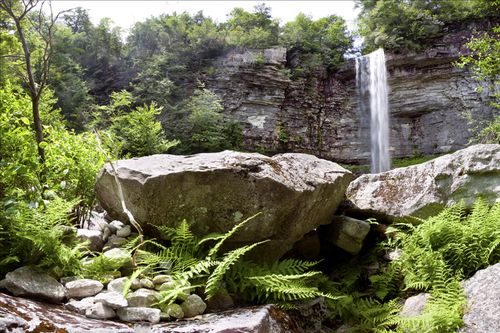
    We're replacing the large four-panel presentation (called a polyptych) on the back wall of the gallery and, when completed, it will present a scene at a scale – about 10' x 7' – that will give the appearance to the viewer of actually standing at the base of the falls.

    Years ago, in the airport in Fort Lauderdale, Florida, we saw a giant wall display of a Clyde Butcher scene from the Everglades so large and captivating that it transcended the notion of a "documentary photograph" and, for a moment, it was almost like being there.

    So, although normally we'd be less inclined to highlight this type of image – an apparent documentation of a natural scene – there is something about the very tactile qualities found in the elements of this scene – delicate ferns, textured rock, flow of water – and the sheer size of the presentation that warranted the decision and, we hope, will evoke in viewers a response similar to the one Butcher's image had on me years ago.


    4053x4


  • Keep It Simple

    I'm always interested in learning about how artists of all stripes approach the creative process.

    There was a very well done piece about the singer-songwriter Paul Simon in the recent issue of ROLLING STONE (May 12, 2011) where he spoke about how he composes his songs, and it struck me that his very cogent and insightful comments could be applied to many creative endeavors:

    Make it as simple as you can.  Take a complex thing and make it as simple as you possibly can.  You're lucky if you ever attain it.  What I'm interested in within art is beauty…. If it's beautiful, that produces an openness of feeling and generosity.


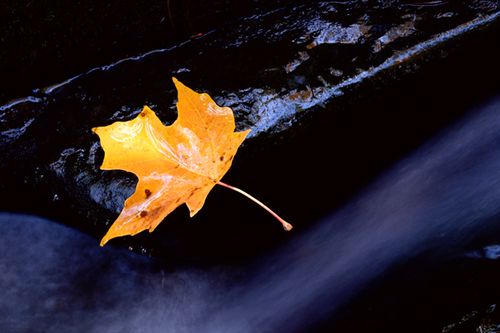
    029 Leaf, Mossy Brook


  • Worth The Journey

    Henry David Thoreau's observations about the singular beauty of an ice-covered and sunlit tree might well be applied to any number of natural phenomena, like the delicate and transitory tree blossoms I encountered along the banks of Lake Mohonk.  Thoreau writes:

    Many times I thought that if the particular tree… were the only one like it in the country, it would be worth the journey across the continent to see it…. But instead of being confined to a single tree, this wonder was as cheap and common as the air itself.


    TreeBloom
  • What The Road Passes By

    Years ago, while traveling through the southwest US,  I met the very talented and personable photographer DeWitt Jones who was shooting for NATIONAL GEOGRAPHIC at the time.  I was just starting to take photography more seriously and was impressed by Jones' friendliness and professionalism. 

    In the course of the day spent shooting, he showed me a book he had published a few years prior entitled: "What The Road Passes By" — a photo essay on the hidden beauty lurking just off the beaten path.

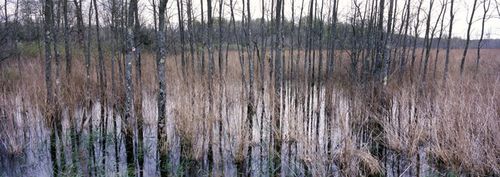
    I thought of Jones and that book last night when I stopped along the side of the road in a suburban neighborhood to capture some spring images of a flooded woodland scene.  I remarked to the homeowner who came out to see what I was up to that, without knowing the story behind it, most people looking at the images would assume they were made in a remote location far from civilization.

    It's what the road passes by….

    _MG_9407