I came across this thoughtful and provocative video narrated by the late physicist Richard Feynman, about how science informs his perception of natural beauty, as well as his worldview. Even if one disagrees with his personal conclusions, his insights and willingness to ask important questions is refreshing.
-
Visceral
Just read about an exhibit of the W.M Hunt photography collection at the George Eastman House in Rochester, NY that included this advice Hunt gives new collectors:
Open yourself up to the visceral experience of looking at photographs and pay attention to what makes your heart beat faster—not what makes your head pound.
What a refreshing sentiment and one that should be considered when experiencing any creative expression — from music to poetry to visual art.
-
The Creative Process
I never tire of learning how the creative process is manifested for others and came across an article in the most recent CHRONOGRAM about author Esmerelda Santiago where she talks about her own experience, which is remarkably similar to so many others:
I really don't believe I'm creating anything. What I'm doing is setting down something that's coming to me from some mystical source that I don't understand, but don't want to get mad at me. [laughs] I really believe these muses as an artist are these forces that are there to help you and nurture you, but you have to help them, too.
-
Going Deeper
That's the title of the show we're working on here at the gallery, and refers to our ever-evolving effort to explore what lies beneath the surface of an image. It was the advent of the large-format nature photography book in the 1970's, most notably the Sierra Club book that paired Eliot Porter images with selections from Thoreau's journals, that provided us the first clue there may be more to a photo than meets the eye.
Since then, and following in the manner of Porter, we've tried to do more than simply document the landscape photographically. This latest effort, printing images on a variety of alternative media, is simply one more layer removed from the representative landscape and towards the expressionistic.
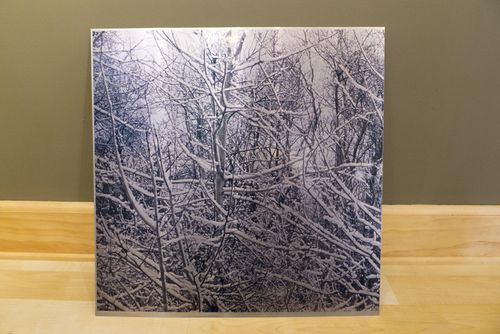
For the show we've tried to choose media that complement each of four different images: fabric for a spring panoramic, canvas panels for summer, wood for autumn and aluminum panels for an icy winter scene.
Here is a photo of one of the ten 2'x2' panels that will make up the final 4' x 10' winter scene.
-
Your “Gloria”
I never seem to tire of examining what it is that contributes to creative endeavors and I came across this passage in the novel "Cutting For Stone" by Abraham Verghese in which the adult Matron is chastising the child Marion for being lazy:
How easily Matron probed the gap between ambition and expediency. "Why must I do what is hardest?"
"Because, Marion, you are an instrument of God. Don't leave the instrument sitting in it's case, my son. Play! Leave no part of your instrument unexplored. Why settle for 'Three Blind Mice' when you can play the 'Gloria'?"
…"But, Matron, I can't dream of playing Bach, the 'Gloria'…,"
"No, Marion," she said…. " No, not Bach's 'Gloria.' Yours! Your 'Gloria' lives within you. The greatest sin is not finding it, ignoring what God made possible in you."

-
Artist’s Wish
It's always entertaining to search for and discover quotations I can pair with the images on the calendar I publish every year – here's one of my favorites from the upcoming 2012 calendar:
I would like to paint the way a bird sings
– Claude Monet
-
“The War of…
Art" and "Anything You Want" are two very brief but very powerful books on the creative process, though they take very divergent paths.
Steven Pressfield's "The War of Art" is a manifesto urging the reader to conquer resistance — the resistance that prevents us from doing what it is we need to do. At times admonishing and at times metaphysical, this is the kind of book one wants to keep close at hand as a reminder when straying from the task at hand. As an Esquire review put it, Pressfield's book is: "…a kick in the ass."
Conversely, Siver's "Anything You Want" is an abbreviated inside look at Derek Sivers' ten-year adventure as the founder of CD Baby, an early online music business. Sivers, a musician, makes it clear he has the discipline to do what it is he sets out to do and it's a fascinating read. The upshot: be sure that whatever it is you are doing serves the ultimate goal of being happy. He concludes that money and possessions are not as important to him as the freedom to live a more nomadic life — a very unusual but refreshing conclusion from a "successful" business-owner who made millions from his brainchild.
Both worth a look…
-
What We Know
A friend sent me this link about how what we know — or don't know — clearly affects our perceptions…
-
Perfect Day For…
Yesterday was a perfect summer day, and a friend and I set out early to enjoy the morning and see if we could capture some images.
The sky was a cloudless blue – it was the kind of day that visitors to the gallery often remark is, "the perfect day to take pictures." I don't usually bother to correct them: those are the nicest days to be out with a camera, but they are the most difficult for a landscape photographer, since a sky without clouds tends to also lack personality.
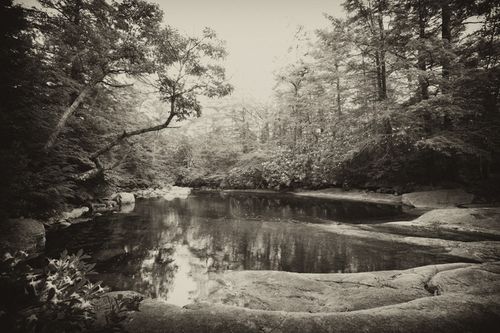
We hiked along one of the many streams in the area and, as I wrote about in an earlier post, I liked the composition of many of the images but not the color — a homogenous summer green.
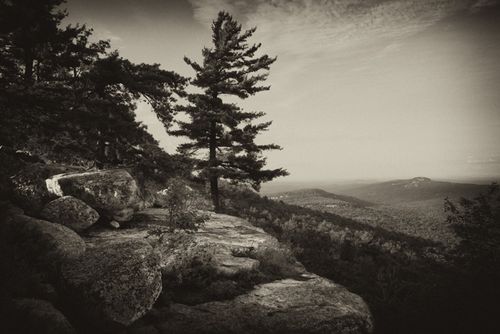
I converted to B&W, as I did the earlier image, and the end result expresses, for me, the timeless feeling of this setting.
-
Soulful
I read a wonderful interview with the actor Wendell Pierce, who plays the laconic Antoine Batiste in the HBO series Treme, about New Orleans after Hurricane Katrina. If you haven't seen this series yet, consider putting it on your Netflix queue, if only for the musicians featured, like Dr. John and Kermit Ruffins.
Pierce, a New Orleans native, talks about the vital music scene there and observes that how music is played — from the heart — "soulful" — is just as important, if not more so, than hitting all the notes.
On reflection, that's probably true for most creative endeavors, including photography. If a work of art — poem, painting, photo – doesn't speak from that soulful place, then ultimately it doesn't really connect with the audience on the level that art should.