Author: G. Steve Jordan
-
Without Art….
According to some, and I don't disagree, my last post may have been a bit heavy. Though I stand by the sentiment, there may be better ways of expressing it.
Visited St. Petersburg, FL recently and was encouraged by the renaissance of art, esp. in the 600 block of Central Avenue, where we acquired some works by the very talented and prolific Coralette Damme, aka the Crafty Hag. (http://www.craftyhag.com)
On her website we came across an unattributed quote that expresses in different terms, the sentiment expressed by William Carlos Williams, but with a bit more levity and joie de vivre:
"“Without art, we’re all just monkeys with car keys.”
-
Not By Bread Alone…
"It is difficult to get the news from poems, yet men die miserably every day for lack of what is found there."
William Carlos Williams
… and what is found there is the essence of any creative endeavor…
-
Freedom
"… the most expensive thing in life is free time for creative expression.”

-
Ambiguity
I was listening to an interview with engraver and portrait artist Bernard Moser speaking about a new book that had been published recently featuring one hundred of his portraits.
The interviewer commented on the fact that the subjects were often pictured in poses that did not reveal the entire face of the sitter. Moser admitted as much and when on to explain that leaving out some details made for a stronger, more memorable likeness. "I find the more ambiguity there is in a work, the more expressive it can be."
As a photographer I found this especially interesting, since we are, for the most part, limited to the reality before the lens. But I've also found, as I've noted before, that sometimes it is the smallest portion of a landscape that can be the most revealing.
I realized the same quality of ambiguity that Moser observes can make a portrait more expressive may be applied equally well to the creation of an expressive landscape. Ambiguity yields expressiveness.
-
New Eyes
I was listening this morning to radio host Scott Simon interviewing Donald and Lillian Stokes, authors of the Stokes Field Guide to Birds celebrating it's 30th anniversary.
They were out with Simon in a park in urban Washington, D.C. and were seeing a number of birds common to anyone's backyard bird feeder, including black-capped chickadees.
Donald Stokes said people often ask : "After thirty years, don't you get tired of seeing the same birds over and over?"
"No, I never do," he replied, and went on to note that he always seemed to find something to admire about or learn from each sighting, even of a common bird. "The challenge in life," he went on, "is not finding new places, but having new eyes."

-
Snapshot
When I see well-composed, sharp photographs, let's say in a travel magazine or at a camera club, I think of Ansel Adams' comments that he had: "…seen a lot of sharp photos and fuzzy concepts." "Snapshot" is the term that comes to mind: an image that does no more or less than document what happened to be in front of a camera lens at the time.
I had a conversation at the gallery this past week with a couple who were admiring the images and commenting on the reality of each image capture – namely how easy it was to view the photos and forget that the photographer – me – was present at each scene – winter and summer, early and late – and got to experience the entire scene, not just a visual representation of it.
Though they are right about that, of course, I then suggested to them that, once the photograph is made, printed, displayed and acquired, it may take on iconic qualities that move the image beyond the "snapshot" Adams spoke of and transcend the reality of the experience. To my way of thinking, that is actually what I am hoping for when I photograph.
After some time passes and an image has been on display or available at the gallery, it seems to me the qualities that make some images appear more evocative than others have little to do with the actual scene itself, or even the photographer. They become a presence in their own right – just as real as the "reality" from which they were plucked.

-
Satisfied
I was out yesterday afternoon for about three hours, hiking up the east side of the Shawangunk Escarpment along one of the new access points available since NY state purchased the land from developers some years ago — thank you NY state!
The afternoon was warm and breezy, the colors at their peak and, though I enjoyed my stroll immensely, I was not captivated by any particular scene and made only one photograph — this one just before I arrived back at my car.
I glanced up to see a tree in peak yellow foliage with leaves fluttering in the wind and decided to leave the shutter open to capture a more impressionistic effect. To my mind, I succeeded in achieving the effect I'd envisioned.
I've been telling visitors to the gallery that because I've spent so much time on the Ridge recording what I've seen, I no longer feel as compelled to photograph similar views. My response to the scene here is a reflection of my search to now portray the beauty of the natural world in alternative ways.
I came across a quote of photographer Julia Margaret Cameron (1815-1879) that eloquently sums up how I feel about my images thus far of the Shawangunk Ridge: "I longed to arrest all beauty that came before me, and at length the longing has been satisfied."

-
Skytop

I'd like to share with you another image from a recent photo outing, taken just below the Skytop monument, our area's most iconic feature and, for me, a psychic pivot point around which I seem to be drawn, not unlike a moth to a flame.
There is a school of painting in Japan that includes their Mt. Fuji in any painting – that seems to be the way I feel about Skytop, even though it is a manmade feature of the landscape (a stone tower constructed to memorialize the passing of one of the Smiley twin brothers, founders of the spectacular Mohonk Mountain House) and even though it is not actually in every photograph I make of the area.
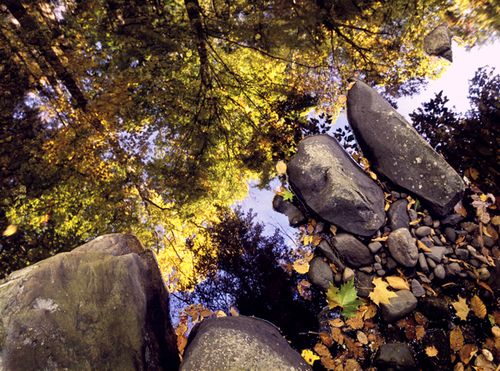
I was hiking with a friend when we came across this scene of trees in peak autumn foliage growing among the talus boulders that one finds at the base of the cliffs. I was struck, as always, by the way that life seems to find purchase, and even thrive, in what would appear an inhospitable spot. To my mind, part of the beauty in this image is the juxtaposition of the geometric and unyielding blocks of Shawangunk conglomerate populated by the graceful forms of the trees.
At the end of our trek, we arrived at the base of Skytop where my hiking companion made this photo of me in the waning light of the day.

-
Autumn

I had the pleasure of spending an afternoon photographing the fall foliage with Jo-Ann and Anthony Campagiorni on Sunday. They were kind enough to bid on an outing with me in order to raise funds for St. Luke's Cornwall Hospital.
We had a perfect day – sunny, warm and the foliage at or close to peak color. We talked about a lot of photographic concepts and I had decided prior to our meeting that I wanted to leave them with a few "take-home points."
First one: "what are you trying to say?" The challenge of photography, and really of any creative endeavor, is to distill a personal experience into an evocative (or provocative) final product using the medium you've chosen. Will the image you've framed in your viewfinder deliver that experience to the viewer?
Second tip: for the optimal color, photograph the fall foliage with the light behind the leaves in order to achieve a glowing backlight effect.
And, finally, pay close attention to the edges and corners of the frame. This is where I find it very helpful to use a tripod – it's easier to examine closely how I've framed an image and then make subtle but telling adjustments.