G. Steve Journal

Reflections on photography, art, beauty and the natural landscape.

Author: G. Steve Jordan

  • Ambiguity Re-Visited

    I don't recall where I encountered this pithy observation, but it echoes an earlier post suggesting that less is more:

    "definition of a good photograph: one that is like the definition of a good dream in the sense that pieces have been arranged unconsciously and provide enough form and point of reference for the viewer to find meaning, but enough is left undefined to allow for the viewer's own history, ideas and dreams to find a place."


    P-0394
  • Surfaces

    I read about an exhibit that has just opened at the Dorsky Museum on the campus of SUNY New Paltz and the comments the artist made struck a chord:

    Marco Maggi said that he, for one, does not believe nor will his audience believe that “art is only about ideas — that there is some hidden, complex idea that is so intellectual that few can understand it. No, not at all.”

    “The main issue in this show is surfaces. Our surfaces, how superficial they are. I hope, if anything that I can help encourage people to look, give a second glance…"

    As an apologist for the beauty of physicality and it's primacy over, or at least congruent to "conceptual art", I enjoy when artists disavow or give secondary status to the intellectual component of their art.

    At the end of the day the question one has to answer is "Does the art have heart?"

    P-0392


  • Resolve

    Earlier I wrote about how a scene framed by the camera's viewfinder is a distillation of reality.

    What I am thinking as I look through the viewfinder is: "What do I include in this scene so that it naturally resolves itself within the frame?" If I am successful, the resulting image, though derived from the larger world, is independent of the reality from which it has been plucked.

    Unfortunately, I don't know how to further elaborate on how, exactly, one makes this happen, except to say that I pay close attention to the edges and corners of the frame and sometimes even blur my vision while looking through the viewfinder to see if, in that blurry state, the scene makes sense visually.

    I'll change the framing slightly to allow the scene to "resolve" itself — I can see this and "feel" that it makes visual sense — but I can't say exactly how that happens. Since each scene is different, I'm not sure there is a formula one can apply, though the photographer Henri Cartier-Bresson described the process as:

    "… putting one's head, one's eye and one's heart on the same axis.”

    Indeed.

    2121
  • Inner Vision

    I recently visited the Museum of Fine Arts in St. Petersburg, Florida where one of the shows on display was "Romantics to Moderns, British Watercolors and Drawings."

    The introduction to the show noted that:

     "As the topographic view and observation of nature began to be replaced by the artist's interpretation of landscape convention in an actual locale there was an increasing interest in expressing emotion and an inner personal vision which are closely associated with the literary and artistic movement of Romanticism." [emphasis mine]

    Photography at this time (last half of the 19th century) was influenced by the same aesthetic (called Pictorialism) and it was as a counterpoint that the f/64 photo group was formed, it's most notable members being Ansel Adams and Edward Weston. These photographers sought to produce what they termed "straight" photography, absent the affectation of the Pictorialists.

    Though they succeeded in defining a new aesthetic in photography, one can make the case that the resulting images continue to express emotion and an inner personal vision but in a fashion unique to the artists and the medium of photography.

    One has to ask, doesn't all artwork ultimately express emotion and an inner personal vision?


    P-0306


  • Distillation

    When I am teaching workshops, I emphasize the importance of the frame, and of using the edges and corners that appear in the viewfinder to help compose the final image.

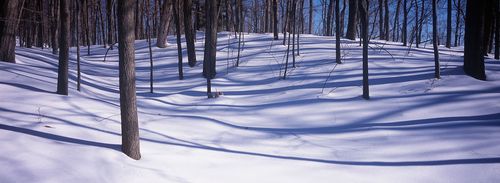
    I've been out skiing a few mornings a week and have been alternating between cameras — carrying either my panoramic camera or a standard format digital camera — which present very different viewfinders in which to compose an image.

    Going back and forth between the cameras as I've been doing really brings home how much the viewfinder, and the discipline it imposes, affects the images I come back with.

    Curiously, I find the exaggerated horizontal view of the panorama format easier to work with.  Rather than finding the more restricted frame a challenge, it actually allows me to distill the scene more easily into what is important.

    It's this challenging process of identifying and then isolating a particular portion of the world — distilling the scene's fundamental essence — that is at the heart of creative landscape photography.

    328
  • Beauty Revealed

    When winter snows blanket a landscape they not only hide detail but, conversely, reveal much that is otherwise invisible when snow is not present.

    Henry David Thoreau noted this with respect to the comings and goings of the animals in Walden woods, commenting on the network of tracks criss-crossing the landscape around his cabin.

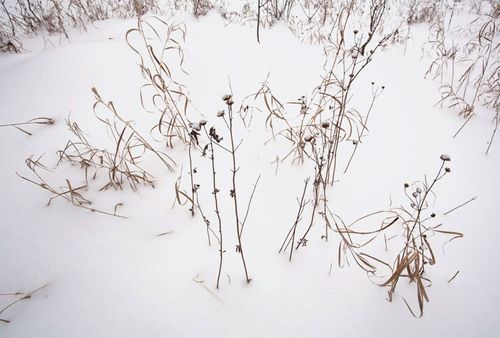
    However it's also true of stationary elements that, without the benefit of a snowy backdrop, would go mostly unnoticed.  I've made a number of images of the dried plants and grasses that remain above the snowy landscape.

    These austere elements, framed just so, can yield delicate and surprisingly beautiful patterns against that pristine white backdrop.


    WinterGrasses

  • Snow!

    Out of the bosom of the Air,

    Out of the cloud-folds of her garments shaken,

    Over the woodlands brown and bare,

    Over the harvest-fields forsaken,

    Silent, and soft, and slow

    Descends the snow.

                        Henry Wadsworth Longfellow


    1165
  • Relevant?

    The latest issue of Photo District News (PDN) contains a Q&A with Stephen Mayes, Managing Director of the photo agency VII, where he is asked: "Are photojournalism contests still relevant?"

     The question that really begs for an answer – "Is photojournalism itself relevant?" – comes up in Mayes response that photojournalism has become more romantic than functional: "There are certain [visual] codes that recur. What I tend to find is that so much journalism we see is about affirming what we already know…."

     That's been true for some time now, but with the ubiquity of visual images and the increasing sophistication of the audience, one may argue that the genre of photojournalism – a single image or series of images revealing a previously hidden truth – has been exhausted.

     However important images may be to us as we process world events, they no longer have the ability to shock and inform.  Images from the heyday of photojournalism like those of the RFK assassination or the Vietnamese girl burned by napalm and running naked down the street are no longer possible.  Not because horrific events are no longer occurring, but because, by ongoing and frequent exposure to the wider world, we've become naturally desensitized.

    When we learn about an event, say the tragic shooting of Representative Giffords in Arizona, we can easily predict the imagery that will follow: medical crews and police behind crime scene tape, shocked and mourning groups of bystanders, shrines created with candles, signs and photos, marchers protesting violence….etc.  We view them and appreciate these images in the same way we enjoy comfort food – for the assurance they provide.

    But relevant? Not so much….
     

  • Fire and Light

    In the previous post, I quote the art reviewer Roberta Smith classifying the glass artist Dale Chihuly as a "lightweight."

    Concidentally, there was a fascinating biopic about Chihuly on channel Thirteen last night – "Fire and Light" – that included appearances by a number of art heavyweights, including the former director of the Metropolitan Museum of Art, Thomas Hoving.

    Hoving is a fan of Chihuly and, after watching the one-hour special, it was hard not to admire the range and depth of Chihuly's work, the prolific output and his dedication to continually pushing the creative envelope.

    Watching him at work, it seems clear that Chihuly is relying moment-to-moment on his unique artistic inner voice to guide the creative process and perhaps that is what Smith finds troubling – the premise of his work does not spring from an intellectual construct.

    Well, if Chihuly is a lightweight, I'd consider it a compliment to be included in that category.

  • Trite?

    Once again, beauty takes it on the chin. 

    In a Jan 13, 2011 NY TIMES review, Roberta Smith, commenting on the aerial landscapes of J. Henry Fair, notes the dissonance between the aesthetic appeal of the abstract photographs and the message of environmental degradation they portray: "… a strange battle between medium and message, between harsh truths and trite, generic beauty."

    Curiously, Smith does not make clear why the beauty of the images, separate from their origin, is "trite" or "generic."  The implication seems to be one that haunts the art world; namely that "beauty" without a conceptual underpinning is not worth our consideration.

    Smith concludes that: " They evoke the work that usually falls on what might be generously called art’s lightweight side, from Bouguereau’s academic nudes to Dale Chihuly glass sculptures."

    Here again, it appears that "lightweight" refers to art absent concept.

    Is there no room in the art world for the emotional apprehension of beauty unmoored from intellect?