G. Steve Journal

Reflections on photography, art, beauty and the natural landscape.

Author: G. Steve Jordan

  • Do The Deed

    I noted in an earlier blog post that my passion for capturing the iconic landscapes of the 'Gunks has abated.  More accurately, I feel that I've mostly satisfied the appetite I once had to express this unique landscape by conventional photographic means.

    I often remark how lucky I am to have had an opportunity to "discover" the area through imagery and was reminded of this when I came across a snippet of a Keats poem.  Keats desired to distill the essence of the natural world poetically and he writes that in the ideal life he would ask for ten years:

     " …so I may do the deed
    That my own soul has to itself decreed."

    Thankfully, I've had those ten years.

    Of course, I'll always enjoy and photographically express the 'Gunks exceptional landscapes, like this image I captured yesterday after the storm. How could I not?

    But I expect I'll be capturing fewer iconic landscapes and, like my mentor Eliot Porter, continue to look more deeply for scenes and methods that will bring a new and different expression to my work.
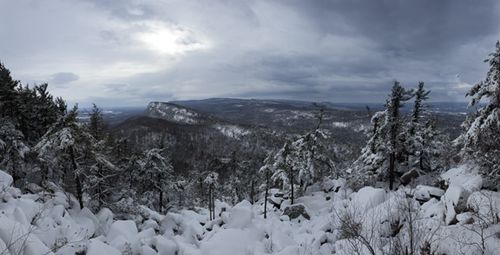
     

    CloveWinterPano
  • Inspiration or Entertainment?

    Watching a documentary on the Ovation channel about photographers, including Susan Meisalas I was struck by her reflecting upon what it is that viewers of her images take away.  She concludes that it's just not possible to know.

    As the cameras panned around the exhibit at the ICP and she commented on the cinematic quality of her work, esp. in Nicaragua, and I couldn't help but feel that by presenting the work in large, beautiful, colorful prints the majority of the audience, rather than being moved to action or touched by the people they see portrayed, felt an otherness from the subjects  – almost as if the images they were viewing were part of what might as well have been a fictional narrative, rather than a documentary one.

    I experienced similar thoughts when attending a presentation by Art Wolfe where he presented pristine landscape photographs of a hitherto unexplored area of the Himalayas.  Rather than cultivate or inspire in the viewer a sense of stewardship for the natural resources of our planet, the images were so otherwordly that, despite their beauty, they were off-putting in their distance from what is real to most of the residents of the planet.

    So, the question is: Can photography still reveal truths and inspire action and change, or has the medium evolved in the minds of most of us into simply entertainment?

  • Sensations

    A theme that I seem to return to again and again is the notion that creative endeavors exist on a different plane than the language we must use to describe both the effort of their creation and the result of it – the art.

    So much of what is called art these days springs from a conceptual foundation – it's almost a game to puzzle out what the artist "meant."

    I came across a wonderful line of a Keats poem in an essay:

    “O for a life of sensations rather than of thought”

    Exactly!

    2301
  • Times Square 2010

    I've been posting to facebook about my assignment of the last dozen years to document the ball drop at TImes Square on New Year's eve and thought I'd include a link to a short video that provides a behind-the-scenes look at our location, the set-up and the ball drop.

    HAPPY NEW YEAR!!

  • Black Swan

    Saw the movie Black Swan last night.  Well worth seeing and a fitting commentary to my earlier question about whether a balance can exist between excellence and sacrifice. (12/24)

    It's hard to come away from a story like this and conclude that balance is possible if one's goal is to be at the pinnacle of one's craft…..

  • Not In The Mood

    I've been a longtime fan of the cartoonist Lynda Barry, whose quirky view of the world is amusing and spot-on at the same time.  Over the years Ann and I have collected many of her comic collections and a few years ago we attended and enjoyed immmensely the Off–Broadway performance of her play, "The Good Times Are Killing Me."

    When I saw that she had put together a book about creativity entitled "What It Is," I immediately ordered it.  Though it's not quite what I expected (typical Lynda Barry) it's crammed with doodles, comic characters and pithy observations on creativity.

    Here's one such pearl of wisdom:

    "It took a long time to realize that I didn't need to be in the mood to move my brush before I picked it up," she writes. "All I needed to do was move the brush and my mood would follow the trail."

  • Sweet Spot?

    I've been reading Andre Agassi book "Open" about his life in tennis.  I really don't care much about tennis but his story is really more about a life of dedication to perfecting a craft, though tragically, the impetus to do so comes from Agassi' domineering father and Agassi' desire to please him.

    And just a few nights after starting the book, I viewed a fascinating biopic on legendary football coach Vince Lombardi, infamous for once declaring: " Winning isn't everything, it's the only thing."

    One feels equal parts admiration and pity for these men: admiration for the achievements and success they realized by a relentless pursuit of perfection, and pity for what they ultimately sacrifice to achieve this perfect state.

    One comes away from these accounts asking: "Can excellence be realized in a more balanced way?"  No one would argue that discipline, persistence and sacrifice are necessary at times in order to achieve objectives.  But where does the cost begin to outweigh the benefit?  Where is the sweet spot?

  • Byproduct

    I was watching an Ovation channel program on photographers, including Jay Maisel, the fiercly bright, opinionated and prolific photographer who was talking about the reason he photographs: because he loves the beauty of the subject (I'm paraphrasing here).  He then went on to say that the resulting photograph is really just an after-effect of that love: "The product is the byproduct."


    4055
  • From what?

    This week's NEW YORKER has this snippet worth sharing.  It's part of a 1964 transcript from the trial of one Josef Brodsky, a twenty-three-year-old poet arrested by the KGB and charged with "malicious parasitism."

    JUDGE: And what is your profession?
    BRODSKY: Poet. Poet and translator.
    JUDGE: And who told you that you were a poet? Who assigned you that rank?
    BRODSKY: No one.  (Non-confrontationally.) Who assigned me to the human race?
    JUDGE: And did you study for this?
    BRODSKY: For what?
    JUDGE: To become a poet. Did you try to attend a school where they train [poets]…. where they teach….
    BRODSKY: I don't think it comes from education.
    JUDGE: From what, then?
    BRODSKY: I think it's….(at a loss)…. from God.