G. Steve Journal

Reflections on photography, art, beauty and the natural landscape.

Author: G. Steve Jordan

  • What Else Is There?

    I’ll always remember the evening I saw my first movie by director Terence Malick — “Days of Heaven.” It made such an impression on me that I walked out of the theater with the friend who’d suggested we go, said “Good night,” went back into the movie theater and paid to see it again.

    The cinematography was unlike anything I’d ever seen before and I have no doubt that it influenced how I view the world, even as I pursued a still photography career for decades following that experience.

    I’ve since transitioned to video and now attempt to emulate the Malick aesthetic when I can. I recently came across an interview of his where he discussed his approach, concluding with this telling observation:

    “…these films can enable small changes of heart, changes that mean the same thing: to live better and to love more. And even an old movie in poor and beaten condition and can give us that. What else is there to ask for?”

    [via]
     

    4050

  • Find a Good Way

    I came across an impassioned argument against seeking a secure “day job” by French novelist Gustave Flaubert and was reminded of an influential book I read some years ago by Lewis Hyde entitled “The Gift” which explores, in great depth, the struggle to both be creative and also pay the bills in a market-based economy.

    A story about Hyde in the NY TIMES described the dilemma like this:

    In the course of writing “The Gift,” Hyde underwent an intellectual transformation on this subject. He began the work believing there was “an irreconcilable conflict” between gift exchange and the market; the enduring (if not necessarily the happy) artist was the one who most successfully fended off commercial demands. By the time he was finished, Hyde had come to a less-dogmatic conclusion. It was still true, he believed, that the marketplace could destroy an artist’s gift, but it was equally true that the marketplace wasn’t going anywhere; it had always existed, and it always would. The key was to find a good way to reconcile the two economies.

    I found the book to be interesting and inspiring, even though it’s not an especially easy read — Hyde’s keen intellect and the broad scope of his arguments can be intimidating in places.

    [via]


  • Try To Imagine

    There are as many reasons that humans feel the need to express themselves creatively as there are humans, but one significant one – to try and create the world we wish to live in – was described in very real terms by writer Mohsin Hamid as an antidote to the anxiety one is likely to feel in a place like the Middle East:

    And for me, writing books and being, you know, someone who's politically active is part of that. I don't want to be anxious on my day-to-day life. I want to try to imagine a future I'd like to live in and then write books and do things that, in my own small way, make it more likely that that future will come to exist.

    [via]

  • Just Do It

    After viewing the incredibly well done documentary "I Am Another You" I wanted to learn more about filmmaker Nanfu Wang and found this posted on her website:

    My company is called A Little Horse Crossing The River, and it's from a story that my dad told me when I was six or seven, and he passed away when I was 12. So in my whole life, I always wanted a father figure that could tell me, "Hey, this is the right thing to do," or, "This is the wrong thing to do." But I never had that. But the story he told always stayed with me.

    The story is about a little horse, and one day the mother horse asked the little horse to go across the river to get something, but the little horse had never crossed the river and he went and came back in a few minutes and the mother horse said, "Did you get the thing that I asked you for?" And he said, "No, because I didn't go," and the mother went, "Why?" And he replied, "I got to the river, yet the squirrel in the tree yelled at me and said, 'You will drown in the river, my father even died, it's so deep,'" And he stepped back, and the buffalo in the river said, "No, no. It's okay. You can cross easily. The level of the water is only at my ankles."  And so he didn't know what to do and he came back to ask the mom.

    My dad told me, "Lots of people will tell you advice based on their own experience, what they think is right. And oftentimes that advice would be contradictory, and you only need to try it yourself to find it out." And I felt that was true with every stage as I was making the film, because from pre-production to distribution, you get all the people's opinions, and I feel you need to follow your heart and just do it and find it out yourself. That's my advice. 


  • Hold Onto This

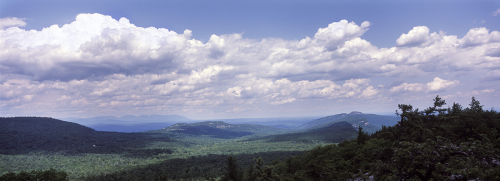
    Recently listened to a fascinating interview on the TED radio hour with music director and conductor Michael Tilson Thomas.  Towards the end of the interview, he reflects on the powerful emotional response that music is able to elicit and his observations made me wonder if the desire to preserve a treasured moment is perhaps the basis of art.  It certainly describes the feeling that compelled me in my attempts to capture the stunning natural beauty of the Shawangunk Ridge:

    Very often when people experience something which is profoundly beautiful, which seems to be right on the edge of the highest perfection one can imagine, that they have this experience of tears coming into their eyes — maybe they’re smiling but they still have tears in their eyes. I’ve always asked myself: “Why is that?” And I think it’s because in the contemplation of something that is perfection, that something in our mortal nature says, “And this can’t possibly last. As much as I would like to hold onto this and be in it forever I know that that can’t be so, so there’s this sense of loss and some kind of underlying sense of longing, of wishing one could somehow hold onto it or be assured of returning to it.

    [via]


    2160


  • Fight Your Way Through

    Spot-on career advice for all creatives from "This American Life" head honcho, Ira Glass:

    "The Creative Process"

    [via]

  • Drawn In

    "The daily routine of most adults is so heavy and artificial that we are closed off to much of the world. We have to do this in order to get our work done. I think one purpose of art is to get us out of those routines. When we hear music or poetry or stories, the world opens up again. We’re drawn in — or out — and the windows of our perception are cleansed, as William Blake said."

                                                                                                                –– Ursula Le Guin

    [via]

  • Being In Uncertainties

    In her provocative book “Being Wrong – Adventures in the Margin of Error” author Kathryn Schulz explores, among other things, the mindset that often prevails in creative fields.

    She observes that “If error is a kind of accidental stumbling into the gap between representation and reality, art is an intentional journey to the same place” and goes on to quote poet John Keats writing to his brother about the same thing:

    … at once it struck me what quality went to form a Man of Achievement especially in literature and which Shakespeare possessed so enormously – I mean Negative Capability, that is when man is capable of being in uncertainties, Mysteries, doubts without any irritable reaching after fact & reason.

    She goes on to note that “If you listen to artists talk about their craft, this concept of “negative capability” – the ability to live comfortably in the presence of mystery and the absence of certainty – comes up with remarkable frequency.”


    P-0157
  • Pure Intuition

    An ongoing theme of these blog posts has been the role intellect plays in creative expression – "art" – versus emotion or intuition.  Here's a telling story from fine-art landscape photographer Andreas Gursky about ignoring his intellectual training and allowing instinct to prevail:

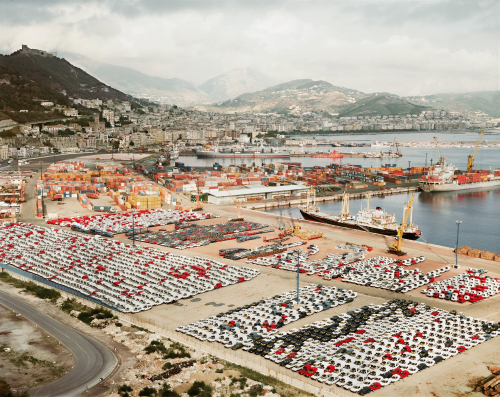
    It was 1990 and I was out driving with my family, sightseeing in and around Naples. Late in the afternoon, we came across this view over the harbour of Salerno. The sun was setting over the city so I had to hurry. I set up my tripod and my 4×5 inch camera, then took four frames. There was no time to weigh up whether it was worth it or not.

    Visually, everything was completely at odds with what I had been taught. My teachers, the conceptual artists Bernd and Hilla Becher, had told me to avoid photographing with sunlight, blue sky or strong shadows.

    I hadn’t been sure the photograph would work. I just felt compelled. It was pure intuition.

    Only when I got back home and put together the first contact sheet did I realise what I had. I saw immediately that pattern, that pictorial density, that industrial aesthetic. This image became an important piece for me, a turning point. It opened up a new sense of possibility, stylistically and thematically

    [via]


    Gursky
  • Don’t Hold Your Breath

    It's very easy to delay the start of a project until conditions are "just right," or refrain from releasing work until it's "perfect."  Sadly, that often means the creative output – song, poem, photo – is never shared at all.  Singer/songwriter Bjork counsels us to view the creative process more like a pipeline that needs always to flow if it is to remain open:

    Like, don’t hold your breath for five or seven years and not release anything, and then you’ve just got clogged up with way too much stuff…Maybe you’ve gained some immaculate, perfect versions of some of the songs, but overall, I think there’s more minus to that because of how you clog your own flow. You lose contact to the part of you, your subconscious, that’s writing songs all the time, and the part of you that’s showing it to the world. As much similarity between those two parts of you, I think, the better. That’s more important, to sustain that flow, than to wait until things are perfect.

    [via]


    P-0315