G. Steve Journal

Reflections on photography, art, beauty and the natural landscape.

  • Relevant?

    The latest issue of Photo District News (PDN) contains a Q&A with Stephen Mayes, Managing Director of the photo agency VII, where he is asked: "Are photojournalism contests still relevant?"

     The question that really begs for an answer – "Is photojournalism itself relevant?" – comes up in Mayes response that photojournalism has become more romantic than functional: "There are certain [visual] codes that recur. What I tend to find is that so much journalism we see is about affirming what we already know…."

     That's been true for some time now, but with the ubiquity of visual images and the increasing sophistication of the audience, one may argue that the genre of photojournalism – a single image or series of images revealing a previously hidden truth – has been exhausted.

     However important images may be to us as we process world events, they no longer have the ability to shock and inform.  Images from the heyday of photojournalism like those of the RFK assassination or the Vietnamese girl burned by napalm and running naked down the street are no longer possible.  Not because horrific events are no longer occurring, but because, by ongoing and frequent exposure to the wider world, we've become naturally desensitized.

    When we learn about an event, say the tragic shooting of Representative Giffords in Arizona, we can easily predict the imagery that will follow: medical crews and police behind crime scene tape, shocked and mourning groups of bystanders, shrines created with candles, signs and photos, marchers protesting violence….etc.  We view them and appreciate these images in the same way we enjoy comfort food – for the assurance they provide.

    But relevant? Not so much….
     

  • Fire and Light

    In the previous post, I quote the art reviewer Roberta Smith classifying the glass artist Dale Chihuly as a "lightweight."

    Concidentally, there was a fascinating biopic about Chihuly on channel Thirteen last night – "Fire and Light" – that included appearances by a number of art heavyweights, including the former director of the Metropolitan Museum of Art, Thomas Hoving.

    Hoving is a fan of Chihuly and, after watching the one-hour special, it was hard not to admire the range and depth of Chihuly's work, the prolific output and his dedication to continually pushing the creative envelope.

    Watching him at work, it seems clear that Chihuly is relying moment-to-moment on his unique artistic inner voice to guide the creative process and perhaps that is what Smith finds troubling – the premise of his work does not spring from an intellectual construct.

    Well, if Chihuly is a lightweight, I'd consider it a compliment to be included in that category.

  • Trite?

    Once again, beauty takes it on the chin. 

    In a Jan 13, 2011 NY TIMES review, Roberta Smith, commenting on the aerial landscapes of J. Henry Fair, notes the dissonance between the aesthetic appeal of the abstract photographs and the message of environmental degradation they portray: "… a strange battle between medium and message, between harsh truths and trite, generic beauty."

    Curiously, Smith does not make clear why the beauty of the images, separate from their origin, is "trite" or "generic."  The implication seems to be one that haunts the art world; namely that "beauty" without a conceptual underpinning is not worth our consideration.

    Smith concludes that: " They evoke the work that usually falls on what might be generously called art’s lightweight side, from Bouguereau’s academic nudes to Dale Chihuly glass sculptures."

    Here again, it appears that "lightweight" refers to art absent concept.

    Is there no room in the art world for the emotional apprehension of beauty unmoored from intellect?

  • Do The Deed

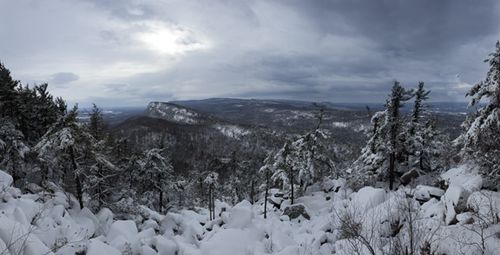
    I noted in an earlier blog post that my passion for capturing the iconic landscapes of the 'Gunks has abated.  More accurately, I feel that I've mostly satisfied the appetite I once had to express this unique landscape by conventional photographic means.

    I often remark how lucky I am to have had an opportunity to "discover" the area through imagery and was reminded of this when I came across a snippet of a Keats poem.  Keats desired to distill the essence of the natural world poetically and he writes that in the ideal life he would ask for ten years:

     " …so I may do the deed
    That my own soul has to itself decreed."

    Thankfully, I've had those ten years.

    Of course, I'll always enjoy and photographically express the 'Gunks exceptional landscapes, like this image I captured yesterday after the storm. How could I not?

    But I expect I'll be capturing fewer iconic landscapes and, like my mentor Eliot Porter, continue to look more deeply for scenes and methods that will bring a new and different expression to my work.


    CloveWinterPano
  • Inspiration or Entertainment?

    Watching a documentary on the Ovation channel about photographers, including Susan Meisalas I was struck by her reflecting upon what it is that viewers of her images take away.  She concludes that it's just not possible to know.

    As the cameras panned around the exhibit at the ICP and she commented on the cinematic quality of her work, esp. in Nicaragua, and I couldn't help but feel that by presenting the work in large, beautiful, colorful prints the majority of the audience, rather than being moved to action or touched by the people they see portrayed, felt an otherness from the subjects  – almost as if the images they were viewing were part of what might as well have been a fictional narrative, rather than a documentary one.

    I experienced similar thoughts when attending a presentation by Art Wolfe where he presented pristine landscape photographs of a hitherto unexplored area of the Himalayas.  Rather than cultivate or inspire in the viewer a sense of stewardship for the natural resources of our planet, the images were so otherwordly that, despite their beauty, they were off-putting in their distance from what is real to most of the residents of the planet.

    So, the question is: Can photography still reveal truths and inspire action and change, or has the medium evolved in the minds of most of us into simply entertainment?

  • Sensations

    A theme that I seem to return to again and again is the notion that creative endeavors exist on a different plane than the language we must use to describe both the effort of their creation and the result of it – the art.

    So much of what is called art these days springs from a conceptual foundation – it's almost a game to puzzle out what the artist "meant."

    I came across a wonderful line of a Keats poem in an essay:

    “O for a life of sensations rather than of thought”

    Exactly!

    2301
  • Times Square 2010

    I've been posting to facebook about my assignment of the last dozen years to document the ball drop at TImes Square on New Year's eve and thought I'd include a link to a short video that provides a behind-the-scenes look at our location, the set-up and the ball drop.

    HAPPY NEW YEAR!!

  • Black Swan

    Saw the movie Black Swan last night.  Well worth seeing and a fitting commentary to my earlier question about whether a balance can exist between excellence and sacrifice. (12/24)

    It's hard to come away from a story like this and conclude that balance is possible if one's goal is to be at the pinnacle of one's craft…..

  • Not In The Mood

    I've been a longtime fan of the cartoonist Lynda Barry, whose quirky view of the world is amusing and spot-on at the same time.  Over the years Ann and I have collected many of her comic collections and a few years ago we attended and enjoyed immmensely the Off–Broadway performance of her play, "The Good Times Are Killing Me."

    When I saw that she had put together a book about creativity entitled "What It Is," I immediately ordered it.  Though it's not quite what I expected (typical Lynda Barry) it's crammed with doodles, comic characters and pithy observations on creativity.

    Here's one such pearl of wisdom:

    "It took a long time to realize that I didn't need to be in the mood to move my brush before I picked it up," she writes. "All I needed to do was move the brush and my mood would follow the trail."