G. Steve Journal

Reflections on photography, art, beauty and the natural landscape.

  • Doors of Perception

    A recent article in the NY TIMES magazine section by Wyatt Mason begins: “A prevailing notion of the lives of artists holds that hedonism is a meaningful part of production,” and goes on to assert that artists may wish to consider an ascetic approach to creativity instead.

    I found it unconvincing and felt compelled to respond in a letter to the editor which included these thoughts:

    Though it’s true that mind-altering substances are used by many in pursuit of pleasure, I’d suggest that the reason artists typically turn to these substances is utilitarian: to overcome the rational mind – the intellect – which often acts as a barrier to new ways of seeing and thinking. Aldous Huxley’s “Doors of Perception” comes to mind in this regard.

    The author somehow fails to see that asceticism and so-called hedonism are merely two sides to the same coin – one in which the creative person seeks alternate paths to the same end: revealing and expressing a latent, but insistent, artistic impulse.

    It’s unfortunate that Mr. Mason perpetuates this myth of the hedonistic artist, providing a convenient excuse for society at large to view the artist pursuing their muse with the help of alcohol or drugs as weak and pitiable and, ultimately, deserving of whatever bad ends they may come to.

  • A Beautiful Form


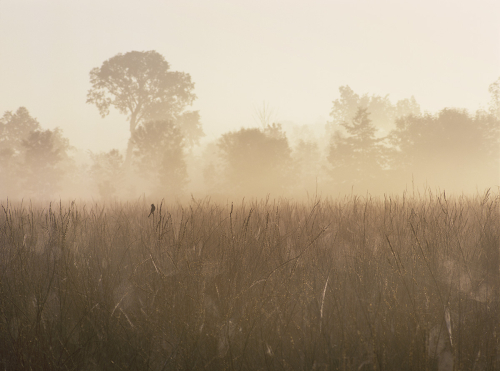
    The dry grasses are not dead for me. A beautiful form has as much life at one season as another.

                                                                                                                   – Thoreau


    P_0301
  • I Couldn’t Say

    In keeping with our ongoing theme of asserting that creative expression often flows from a frustration with language as a stand-in for feelings, we offer this excerpt that artist Georgia O'Keefe included in a foreword to a catalog for an exhibition of her work:

    I found that I could say things with colour and shapes that I couldn’t say in any other way – things that I had no words for…

    [via]

    113 Autumn Reflections


  • And Only Then…

    Author Annie Dillard's telling observations on writing are relevant to creative endeavors generally.  As someone who spent years wandering through nature, searching without knowing what exactly I was looking for, this description is spot-on:

    At its best, the sensation of writing is that of any unmerited grace. It is handed to you, but only if you look for it. You search, you break your heart, your back, your brain, and then — and only then — it is handed to you.

    [via]

    3069
  • Alive

    Many, if not most, creative people – poets, musicians, artists – are motivated by a frustration with ordinary language as the sole means of communicating to others the sense of wonder they experience in the world around them.

    Came across this poetic insight attributed to the ancient Greek philosopher Thales of Miletus and which speaks to this feeling:

    The universe is alive, and has fire in it, and is full of gods.

    [via]

    3067
  • A Much Better Place

    Came across a TED talk by Lux Narayan who, on a whim, decided to analyze 2000 obituaries to see what, if anything, he could learn about life.  Though his conclusions are not specific to the creative community, they certainly deserve our consideration:

    We uncovered, many lessons from lives well-led, and what those people immortalized in print could teach us. The exercise was a fascinating testament to the kaleidoscope that is life, and even more fascinating was the fact that the overwhelming majority of obituaries featured people famous and non-famous, who did seemingly extraordinary things. They made a positive dent in the fabric of life. They helped.

    So ask yourselves as you go back to your daily lives: How am I using my talents to help society? Because the most powerful lesson here is, if more people lived their lives trying to be famous in death, the world would be a much better place.

    [via]

  • Not Feeling

    Came across some thoughts expressed by poet e.e. cummings on being true to one's inner voice and, in keeping with one of the themes of this blog, namely to trust creative instinct over intellect, I thought this pithy observation relevant not only to poetry, but to the creative process in general:

    A lot of people think or believe or know they feel — but that’s thinking or believing or knowing; not feeling. And poetry is feeling — not knowing or believing or thinking.

    [via]

    3068
  • Imagination

    “I call that man rich,” Henry James’s Ralph Touchett observes in “Portrait of a Lady,” “who can satisfy the requirements of his imagination.”

    One may suppose that, for the creative person, meaningful and unique artistic expression is the most compelling requirement…

    257
  • Poetic Vehicle

    As a follow up to our last post, here are filmmaker Ken Burns' thoughtful and enlightening observations on how to tell a story:

    In every film we’ve tried to look for a way to allow the audience space to leave the world that they are in…. How do I transit you from your incredibly busy and compelling life…and bring you to this moment.

    You can’t force people into it by exaggerated drama, you need to say ‘ This is what happened, this is where we’re going to go, will you take my hand… can I lead you to that place?’

    You have the facts in there but you deliver it in a kind of poetic vehicle that makes sense to people.

  • What Life Is About

    Just completed an online class with filmmaker Ken Burns and it was as enlightening and provocative as one would expect from this hyper-articulate and thoughtful genius of storytelling.

    He’s that rare individual who is persistent to a fault, leaving no stone unturned in his art, able to attend to details at the most intimate level and then, in a heartbeat, step all the way back from a project to objectively evaluate the big picture.

    Though Burns spends time discussing and illustrating some of his signature techniques, the real value of the class is in his refreshing take on balancing the inexorable tension between art and craft to achieve a synergy that’s somehow greater than merely the sum of the components.

    Particularly noteworthy were his observations on how to strike that delicate balance:

    That’s what art is… something else…throw away your crutches, throw away the simple things, the obvious illustration and try to achieve something that’s a …little bit more difficult, and dissonant, and you might find new meaning in that.

    If you’re corrigible to the end, then you have the opportunity for serendipity and surprise…. that’s what life is about.

    He concludes with his motivation for pursuing the path he’s chosen by quoting Transcendentalist author Ralph Waldo Emerson in his essay, “Self Reliance”:

    I will do…whatever inly rejoices me…


    M-0056Flt