G. Steve Journal

Reflections on photography, art, beauty and the natural landscape.

  • Moonbeams

    Quite often, when visitors to the gallery are deciding on a purchase, they are attracted at first to a particular photograph but then feel the need to view more of them before circling back to their original selection.  What's interesting is that, when they then seek to describe why they came back to their original choice, words fail them — they can't articulate specific reasons – they just do.

    I came across a quote by author Steven King, about the subtle art of the opening sentence, that helps explain why gallery customers may have such trouble talking about their choice:

                   "To get scientific about it is a little like trying to catch moonbeams in a jar."
  • Magic

    Here's an excerpt from an interview with photographer Camille Seaman in a recent issue of Parabola magazine:

    I suspect there are things we don't have words for.  And if you have a certain quality of sensitivity, they are felt, but no one knows how to talk about it.

    Exactly, exactly.  It's that intangible. Part of the magic of an artist is being able to draw from the intangible and create a physical. That's magic, truly, because you're literally reaching into a void and drawing energy and making something…"


    2159
  • Nothing New…

    From the blog Futility Closet:

    I am astonished at the foolish music written in these times. It is false
    and wrong and no longer does anyone pay attention to what our beloved
    old masters wrote about composition. It certainly must be a remarkably
    elevated art when a pile of consonances are thrown together any which
    way.

    I remain faithful to the pure old composition and pure rules. I have
    often walked out of the church since I could no longer listen to that
    mountain yodeling. I hope this worthless modern coinage will fall into
    disuse and that new coins will be forged according to the fine old stamp
    and standard.

    – Samuel Scheidt, to Heinrich Baryphonus, Jan. 26, 1651

  • Good Enough

    Our western culture places a premium on achieving ever greater measures of success which, paradoxically, can intimidate us from taking the first, crucial steps towards a goal — fear of failure can often prevent forward progress. 

    I came across an interesting interview in the NY TIMES with Jan Filochowski, chief executive of Great Ormond Street Hospital in London, one of the world’s top children’s hospitals, where he talks about the importance of constructively dealing with failure, as opposed to trying to avoid it:

    Q. We have to make mistakes to become better managers?

    A. I’m a huge believer in the 80/20 rule. As long as you get more things right than you get wrong, that’s O.K. And if you wait until you get everything right, you’ll never do anything. You’ll be perfect, but indecisive, and you will fail big-time. That’s one of the things I learned. It’s about achieving not just the O.K. but the good enough. If you focus on the good enough, you get better and better. If you wait to get from the good to the great, I don’t think you’ll ever get to the good.

  • Possibility!

    Many landscape photographers attempt to emulate the results of images already seen, perhaps with slight variations.  We all do this, which is why it's so difficult to bring anything new to the table, especially when visiting an iconic and much photographed area – the Grand Canyon, for example.

    If one has the time, however, and is able to get the cliches out of the way, it is possible to transcend the scene that everyone has seen and realize one's own vision.  That's not to say it's easy, since the objective becomes very amorphous: wander around searching for something you don't know you are looking for.

    The only upside is that the process then becomes one of discovery — more exciting than documentation:

    “If I were to wish for anything, I should not wish for wealth and power, but for the passionate sense of the potential, for the eye which, ever young and ardent, sees the possible. Pleasure disappoints, possibility never. And what wine is so sparkling, what so fragrant, what so intoxicating, as possibility!”

                                                                                                                          – Søren Kierkegaard


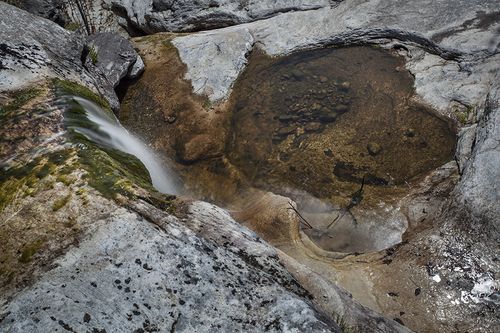
    Pool
  • Being Wrong

    "Whether you are trying to be right, like the realists, or trying not to be right, like the Dadaists, …. the art you make will always be subjective and askew. If error is a kind of accidental stumbling into the gap between representation and reality, art is an intentional journey to the same place."

                                                                                                           Kathryn Schulz

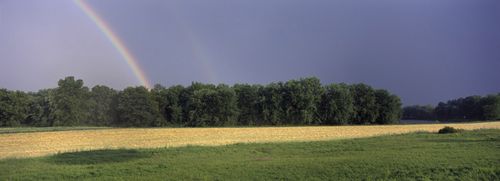
    BearHill2
  • Beauty

    Another excerpt from an interview with photographer Jeff Jacobsen in the April 13 issue of Photo District News (PDN):

    You defended beauty in photographs earlier  [in the interview].  Are you suggesting that contemporary photography tends to eschew beauty?

    I think often it does.  Sometimes beauty has a negative connotation in the photography world, certainly in the photojournalism world, it often is.  And that complexity of form is given this high degree of value.  And sometimes [complex form] really is magnificent.  But sometimes a very simple form – some Andre Kertesz photographs are so formally beautiful but they're very simple.

    When it's really, really working in photography, there is a creative relationship between form and content.


    2150
  • Strange Mood

    One of the deepest and strangest of all human moods is the mood which will suddenly strike us perhaps in a garden at night, or deep in sloping meadows, the feeling that every flower and leaf has just uttered something stupendously direct and important, and that we have by a prodigy of imbecility not heard or understood it. There is a certain poetic value, and that a genuine one, in this sense of having missed the full meaning of things. There is beauty, not only in wisdom, but in this dazed and dramatic ignorance.               

                                                                                            – G.K. Chesterton, Robert Browning, 1903

  • Seeing

    I came across an interesting article about how technological advancements in photography are changing how reality is captured.  The author suggests that the "decisive moment" made famous by photographer Henri Cartier-Bresson will be replaced by the notion of a "constant-moment" of visual recording.  Not sure what I think of this prediction, but I did like the quote that finished the piece:

    Technique is important only insofar as you must master it in order to communicate what you see… The camera for us is a tool, not a pretty mechanical toy. In the precise functioning of the mechanical object perhaps there is an unconscious compensation for the anxieties and uncertainties of daily endeavor. In any case, people think far too much about techniques and not enough about seeing." -Henri Cartier-Bresson


    2092
  • Getting Out of the Way

    A recent piece in the NY TIMES featured the behind-the-scenes photography of actor Jeff Bridges on sets he's been on over the years.  The B&W panoramic images of his fellow actors are exceptional, as is his approach to the process:

    The Widelux [camera] is a fickle mistress; its viewfinder isn’t accurate, and there’s no manual focus, so it has an arbitrariness to it, a capricious quality. I like that. It’s something I aspire to in all my work — a lack of preciousness that makes things more human and honest, a willingness to receive what’s there in the moment and to let go of the result. Getting out of the way seems to be one of the main tasks for me as an artist.