G. Steve Journal

Reflections on photography, art, beauty and the natural landscape.

Category: Uncategorized

  • Freedom

    "… the most expensive thing in life is free time for creative expression.”


    3065


  • New Eyes

    I was listening this morning to radio host Scott Simon interviewing Donald and Lillian Stokes, authors of the Stokes Field Guide to Birds celebrating it's 30th anniversary.

    They were out with Simon in a park in urban Washington, D.C. and were seeing a number of birds common to anyone's backyard bird feeder, including black-capped chickadees.

    Donald Stokes said people often ask : "After thirty years, don't you get tired of seeing the same birds over and over?"

    "No, I never do," he replied, and went on to note that he always seemed to find something to admire about or learn from each sighting, even of a common bird.  "The challenge in life," he went on, "is not finding new places, but having new eyes."


    2301
  • Snapshot

    When I see well-composed, sharp photographs, let's say in a travel magazine or at a camera club, I think of Ansel Adams' comments that he had: "…seen a lot of sharp photos and fuzzy concepts."  "Snapshot" is the term that comes to mind: an image that does no more or less than document what happened to be in front of a camera lens at the time.

    I had a conversation at the gallery this past week with a couple who were admiring the images and commenting on the reality of each image capture – namely how easy it was to view the photos and forget that the photographer – me – was present at each scene – winter and summer, early and late – and got to experience the entire scene, not just a visual representation of it.

    Though they are right about that, of course, I then suggested to them that, once the photograph is made, printed, displayed and acquired, it may take on iconic qualities that move the image beyond the "snapshot" Adams spoke of and transcend the reality of the experience.  To my way of thinking, that is actually what I am hoping for when I photograph.

    After some time passes and an image has been on display or available at the gallery, it seems to me the qualities that make some images appear more evocative than others have little to do with the actual scene itself, or even the photographer.  They become a presence in their own right – just as real as the "reality" from which they were plucked. 

    2283
  • Satisfied

    I was out yesterday afternoon for about three hours, hiking up the east side of the Shawangunk Escarpment along one of the new access points available since NY state purchased the land from developers some years ago — thank you NY state!

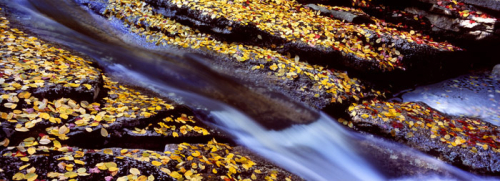
    The afternoon was warm and breezy, the colors at their peak and, though I enjoyed my stroll immensely,  I was not captivated by any particular scene and made only one photograph — this one just before I arrived back at my car.

    I glanced up to see a tree in peak yellow foliage with leaves fluttering in the wind and decided to leave the shutter open to capture a more impressionistic effect. To my mind, I succeeded in achieving the effect I'd envisioned.

    I've been telling visitors to the gallery that because I've spent so much time on the Ridge recording what I've seen, I no longer feel as compelled to photograph similar views.  My response to the scene here is a reflection of my search to now portray the beauty of the natural world in alternative ways.

    I came across a quote of photographer Julia Margaret Cameron (1815-1879) that eloquently sums up how I feel about my images thus far of the Shawangunk Ridge: "I longed to arrest all beauty that came before me, and at length the longing has been satisfied."

    YellowTree
  • Skytop

    _MG_5373


    I'd like to share with you another image from a recent photo outing, taken just below the Skytop monument, our area's most iconic feature and, for me, a psychic pivot point around which I seem to be drawn, not unlike a moth to a flame.

    There is a school of painting in Japan that includes their Mt. Fuji in any painting – that seems to be the way I feel about Skytop, even though it is a manmade feature of the landscape (a stone tower constructed to memorialize the passing of one of the Smiley twin brothers, founders of the spectacular Mohonk Mountain House) and even though it is not actually in every photograph I make of the area.

    I was hiking with a friend when we came across this scene of trees in peak autumn foliage growing among the talus boulders that one finds at the base of the cliffs.  I was struck, as always, by the way that life seems to find purchase, and even thrive,  in what would appear an inhospitable spot. To my mind,  part of the beauty in this image is the juxtaposition of the geometric and unyielding blocks of Shawangunk conglomerate populated by the graceful forms of the trees.

    At the end of our trek, we arrived at the base of Skytop where my hiking companion made this photo of me in the waning light of the day.


    _MG_5389
  • Autumn

    _MG_5346


    I had the pleasure of spending an afternoon photographing the fall foliage with Jo-Ann and Anthony Campagiorni on Sunday.  They were kind enough to bid on an outing with me in order to raise funds for St. Luke's Cornwall Hospital.

    We had a perfect day – sunny, warm and the foliage at or close to peak color.  We talked about a lot of photographic concepts and I had decided prior to our meeting that I wanted to leave them with a few "take-home points."

    First one: "what are you trying to say?"  The challenge of photography, and really of any creative endeavor, is to distill a personal experience into an evocative (or provocative) final product using the medium you've chosen.  Will the image you've framed in your viewfinder deliver that experience to the viewer? 

    Second tip: for the optimal color, photograph the fall foliage with the light behind the leaves in order to achieve a glowing backlight effect.

    And, finally, pay close attention to the edges and corners of the frame.  This is where I find it very helpful to use a tripod – it's easier to examine closely how I've framed an image and then make subtle but telling adjustments.

  • WVLT

    We are collaborating with the Wallkill Valley Land Trust (WVLT) on a project to raise funds for land preservation in the area.

    I've donated a photograph and Craig Shankles of PDQ Printing in New Paltz has kindly agreed to donate printing of a poster that the WVLT will make available for a donation to be determined.

    This is the image we've chosen for the poster which will be printed approx. 15" x 25" and should be available by Labor Day.

    Since the photo and printing have been donated, all proceeds will benefit the Wallkill Valley Land Trust and their land preservation efforts.

    The may be contacted directly at 845.255.2761 or info@wallkillvalleylt.org or see their website at http://www.wallkillvalleylt.org/

    2264

  • Beauty II

    This summer, the Metropolitan Museum of Art is featuring an installation by Doug and Mike Starn, twin brothers, on the roof.  Though I have yet to see it, I understand the installation consists of many thousands of bamboo poles laced together into an organic sculpture.

    What struck me as especially interesting was a quote of theirs from some time ago:

    "Modernism is a very intellectual movement, and beauty's been out of fashion in the art world for quite a while; it's seen as corny," Doug Starn said, 20 years back. "We don't feel that way at all." "Irony plays no part in our art at all," added Mike….."

    What a refreshing notion!

    Clearly, as in most aspects of life, there is not an either/or proposition to consider, but rather a spectrum.  I can't help but agree the "art spectrum" had been co-opted by the more intellectual/conceptual wing…not that there's  anything wrong with that.

    Nevertheless, it's encouraging to hear successful contemporary artists win one for the "casual beauty" camp…..

  • The Gift

    One of the reasons, if not the reason, "conceptual art" has never found purchase in my mind is, I think, because of the very presence of the artist as the source of the conceptual puzzle. It seems to me such an obvious conceit and therefore, regardless of scope or complexity, small.


    Garrison Kiellor observed, "A poem is not a puzzle that you the dutiful reader is obliged to solve." Is it not so for all artistic endeavors?  Does the work register? resonate? provoke or evoke a feeling without our first thinking about it?


    Many artists, myself included, sense that there is something more that results from our creative efforts, usually without being able to precisely describe what that "something" may be.


     Lewis Hyde addresses this notion in his book, The Gift: "…along with any true creation comes the uncanny sense that "I," the artist, did not make the work."  And, wrote D.H. Lawrence. "Not I, not I, but the wind that blows through me." I heard this referred to recently as: "….the secret strangeness that lies beneath the world of appearances."


    One is almost inclined to believe that trying to pin down this elusive quality of artistic expression may result in the destruction or dissolution of it's power – better not to know.  Perhaps it's akin to the curious physics principle that the very act of quantifying the speed or mass of a subatomic particle actually changes the particle.


    Or maybe Louis Armstrong said it best when, asked what's jazz replied: "If you have to ask, you'll never know."


  • Perception

    Reading Jonah Lehrer's book "How We Decide" – not unlike Malcolm Gladwell's bestseller: "Blink" – I'm reminded how much our perceptions of the world are relative.

    In one telling experiment, subjects were asked to rate their favorite strawberry jams from among a dozen or so.  Once that had been accomplished, the researchers asked them to then describe what it was that they liked and why one jam was selected over another.  Finally, they were asked once again to rate the jams.  Surprisingly, the results from the first and second trials were very different.

    The researchers, and Lehrer, account for this by noting that we use two different parts of the brain for each of these two tasks: in the first one our brains are judging the taste…etc. in a non-analytic way — gut instinct, one might say.  Actually, the brain is subconsciously processing lots of information in this mode, just not in a way that we are aware of.

    In the second trial, when the subjects are asked to defend their choices, the "rational" part of our mental processing steps in and attempts to legitimize the ratings.  However, this causes the jam to be experienced differently, in a more intellectual way, and so the gut instincts  (perhaps we can call them our pre-cognitive impressions)  are second-guessed.

    I'm wondering how often this happens when we are contemplating a work of art.  In some cases, it may actually enhance our perception, as when we are informed that the Van Gogh painting before us is the last one he painted before committing suicide.

    More often, I'm guessing, our rational mind second-guesses our gut-feeling and the magic is lost.

    P-0053