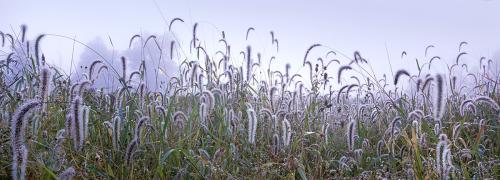
The dry grasses are not dead for me. A beautiful form has as much life at one season as another.
– Thoreau

Reflections on photography, art, beauty and the natural landscape.
The dry grasses are not dead for me. A beautiful form has as much life at one season as another.
– Thoreau
In keeping with our ongoing theme of asserting that creative expression often flows from a frustration with language as a stand-in for feelings, we offer this excerpt that artist Georgia O'Keefe included in a foreword to a catalog for an exhibition of her work:
I found that I could say things with colour and shapes that I couldn’t say in any other way – things that I had no words for…
[via]

Author Annie Dillard's telling observations on writing are relevant to creative endeavors generally. As someone who spent years wandering through nature, searching without knowing what exactly I was looking for, this description is spot-on:
At its best, the sensation of writing is that of any unmerited grace. It is handed to you, but only if you look for it. You search, you break your heart, your back, your brain, and then — and only then — it is handed to you.
[via]

Many, if not most, creative people – poets, musicians, artists – are motivated by a frustration with ordinary language as the sole means of communicating to others the sense of wonder they experience in the world around them.
Came across this poetic insight attributed to the ancient Greek philosopher Thales of Miletus and which speaks to this feeling:
The universe is alive, and has fire in it, and is full of gods.
[via]

Came across a TED talk by Lux Narayan who, on a whim, decided to analyze 2000 obituaries to see what, if anything, he could learn about life. Though his conclusions are not specific to the creative community, they certainly deserve our consideration:
We uncovered, many lessons from lives well-led, and what those people immortalized in print could teach us. The exercise was a fascinating testament to the kaleidoscope that is life, and even more fascinating was the fact that the overwhelming majority of obituaries featured people famous and non-famous, who did seemingly extraordinary things. They made a positive dent in the fabric of life. They helped.
So ask yourselves as you go back to your daily lives: How am I using my talents to help society? Because the most powerful lesson here is, if more people lived their lives trying to be famous in death, the world would be a much better place.
[via]
Came across some thoughts expressed by poet e.e. cummings on being true to one's inner voice and, in keeping with one of the themes of this blog, namely to trust creative instinct over intellect, I thought this pithy observation relevant not only to poetry, but to the creative process in general:
A lot of people think or believe or know they feel — but that’s thinking or believing or knowing; not feeling. And poetry is feeling — not knowing or believing or thinking.
[via]

“I call that man rich,” Henry James’s Ralph Touchett observes in “Portrait of a Lady,” “who can satisfy the requirements of his imagination.”
One may suppose that, for the creative person, meaningful and unique artistic expression is the most compelling requirement…
As a follow up to our last post, here are filmmaker Ken Burns' thoughtful and enlightening observations on how to tell a story:
In every film we’ve tried to look for a way to allow the audience space to leave the world that they are in…. How do I transit you from your incredibly busy and compelling life…and bring you to this moment.
You can’t force people into it by exaggerated drama, you need to say ‘ This is what happened, this is where we’re going to go, will you take my hand… can I lead you to that place?’
You have the facts in there but you deliver it in a kind of poetic vehicle that makes sense to people.
Just completed an online class with filmmaker Ken Burns and it was as enlightening and provocative as one would expect from this hyper-articulate and thoughtful genius of storytelling.
He’s that rare individual who is persistent to a fault, leaving no stone unturned in his art, able to attend to details at the most intimate level and then, in a heartbeat, step all the way back from a project to objectively evaluate the big picture.
Though Burns spends time discussing and illustrating some of his signature techniques, the real value of the class is in his refreshing take on balancing the inexorable tension between art and craft to achieve a synergy that’s somehow greater than merely the sum of the components.
Particularly noteworthy were his observations on how to strike that delicate balance:
That’s what art is… something else…throw away your crutches, throw away the simple things, the obvious illustration and try to achieve something that’s a …little bit more difficult, and dissonant, and you might find new meaning in that.
If you’re corrigible to the end, then you have the opportunity for serendipity and surprise…. that’s what life is about.
He concludes with his motivation for pursuing the path he’s chosen by quoting Transcendentalist author Ralph Waldo Emerson in his essay, “Self Reliance”:
I will do…whatever inly rejoices me…
It can be awkward to try and describe using language what motivates one to create a particular work of art. Often one of the motivating factors is exactly that inability –– if the essence of the artwork could be described in words, perhaps the desire to express it otherwise might not exist. Philosopher Suzanne Langer perfectly describes why language is wanting in this regard:
Every work of art expresses, more or less purely, more or less subtly, not feelings and emotions which the artist has, but feelings and emotions which the artist knows…
Such knowledge is not expressible in ordinary discourse. The reason for this ineffability is not that the ideas to be expressed are too high, too spiritual, or too anything-else, but that the forms of feeling and the forms of discursive expression are logically incommensurate, so that any exact concepts of feeling and emotion cannot be projected into the logical form of literal language. Verbal statement, which is our normal and most reliable means of communication, is almost useless for conveying knowledge about the precise character of the affective life. Crude designations like “joy,” “sorrow,” “fear,” tell us as little about vital experience as general words like “thing,” “being,” or “place,” tell us about the world of our perceptions.
[via]