G. Steve Journal

Reflections on photography, art, beauty and the natural landscape.

Author: G. Steve Jordan

  • Greatest Lesson

    A dominant theme of these posts has been about the tension that exists between intellect and emotion in creating art.

    We’ve featured many observations by artists who, consciously or unconsciously, allow the emotional component of their creative vision to inform the work, like songwriter Allee Willis.

    Willis, who recently passed away, penned many hits, most famously with the band “Earth, Wind & Fire” and she credited band member Maurice White with her success. She describes here, succinctly and poetically, what he taught her about the proper relationship between intellect and emotion:

    I learned my greatest lesson ever in songwriting from him, which was never let the lyric get in the way of the groove.

    [via]
  • No Rules

    Artists seeking a path to express a unique vision typically discover few guides.

    So it's not surprising when they conclude that, though the results may be messy at times, the journey must be respected:

    For what it’s worth: it’s never too late or, in my case, too early to be whoever you want to be. There’s no time limit, stop whenever you want. You can change or stay the same, there are no rules to this thing. We can make the best or the worst of it. I hope you make the best of it. And I hope you see things that startle you. I hope you feel things you never felt before. I hope you meet people with a different point of view. I hope you live a life you’re proud of. If you find that you’re not, I hope you have the courage to start all over again.

                                                                                                    –– F. Scott Fitzgerald

    [via]

    IMG_4821
  • Time Stops

    Here's another excerpt from that recent NY TIMES Op-Ed about beauty, this one from author André Aciman:

    All beauty and art evoke harmonies that transport us to a place where, for only seconds, time stops and we are one with the world. It is the best life has to offer.

    [via]

  • Most Alive

    A recent NY TIMES Op-Ed inquired of artists, writers and designers "Why Is Beauty Important To Us?"

    Here's an observation suggested by actor Constance Wu:

    When we become aware of life’s beauty, that’s when we are most alive.


    3119
  • Alive and Present

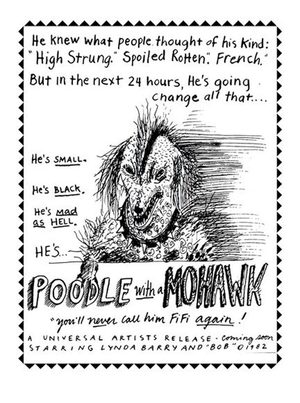
    We’ve been fans of cartoonist Lynda Barry since coming across her unique perspective on the world way back in the 80’s and purchasing her unforgettable poster: “Poodle With A Mohawk.”

    A recent and well-deserved recipient of the Macarthur “Genius Grant”, Barry has offered advice about harnessing the creative process for decades, including this observation:

    ….there are two working languages in human life. One is sort of top of the mind, what we’re conscious of. The other is this unconscious stuff that we might not know about or have access to. The way we access it is usually through this thing we call ‘the arts.’ Unfortunately, that has gotten removed from the regular daily experience of human life. What I’m trying to do is to show that there is a way that they can come together, and that you can make things in a way that makes you actually feel alive and present.

    [via]

    Poodle with a Mohawk
  • Trying To Be Born

    When asked by an interviewer about the motivation for his work, Kiowa Indian author and poet N. Scott Momaday quoted fellow writer William Gass:


    I don’t write for myself, that would be self-serving
    I don’t write for an audience, that would be pandering
    I write for the thing that is trying to be born

    [via]

  • Unknown Known

    Whether you succeed or not is irrelevant — there is no such thing. Making your unknown known is the important thing — and keeping the unknown always beyond you.

                                                                                                                –– Georgia O'Keefe

    [via]


    M_0210
  • Just Enough

    With the recent opening of the movie "Motherless Brooklyn," Daniel Riley interviewed actor/director Edward Norton in a piece the appeared in GQ.

    Like all artists who strive to find their own creative path forward, Norton describes the challenges of executing his vision:

    I don’t think it was different for Melville,” he says. “I don’t think it was different for Walt Whitman. Everybody who’s ever tried to communicate through work has struggled with the needs of the ego, and the higher aspirations toward patience and conviction that the work really is just enough.

    [via]

  • Send Out All Your Dogs

    Though many of Werner Herzog’s tips for filmmakers are specific to that craft, the wild and restless spirit invoked is one that could well be applied across all creative endeavors:

    1. Always take the initiative.
    2. There is nothing wrong with spending a night in jail if it means getting the shot you need.
    3. Send out all your dogs and one might return with prey.
    4. Never wallow in your troubles; despair must be kept private and brief.
    5. Learn to live with your mistakes.
    6. Expand your knowledge and understanding of music and literature, old and modern.
    7. That roll of unexposed celluloid you have in your hand might be the last in existence, so do something impressive with it.
    8. There is never an excuse not to finish a film.
    9. Carry bolt cutters everywhere.
    10. Thwart institutional cowardice.
    11. Ask for forgiveness, not permission.
    12. Take your fate into your own hands.
    13. Learn to read the inner essence of a landscape.
    14. Ignite the fire within and explore unknown territory.
    15. Walk straight ahead, never detour.
    16. Manoeuvre and mislead, but always deliver.
    17. Don't be fearful of rejection.
    18. Develop your own voice.
    19. Day one is the point of no return.
    20. A badge of honor is to fail a film theory class.
    21. Chance is the lifeblood of cinema.
    22. Guerrilla tactics are best.
    23. Take revenge if need be.
    24. Get used to the bear behind you.

  • Leave Room

    Musician, composer, producer Quincy Jones is profiled in an extraordinary documentary – "Quincy"– directed by his daughter, actor Rashida Jones.  The breadth and scope of his career and the mark he's made on the music scene is incalculable, yet he remains humble and accessible.

    Though clearly a workaholic and driven to succeed, he understands that the creative process is fickle, counseling fellow musicians:

    Leave room for the magic … the magic of the moment


    113 Autumn Reflections